Table of Contents
Memorial Tablet by Siegfried Sassoon: Poem Analysis – Discover a powerful anti-war poem that exposes the grim reality behind WWI memorials. In Memorial Tablet by Siegfried Sassoon, the celebrated war poet delivers a biting critique of class pressure, pointless sacrifice, and the hollow glory of battlefield death. Written in 1918, this sonnet remains one of the most haunting examples of trench poetry, using irony and raw imagery to challenge romanticized views of war. This in-depth Memorial Tablet by Siegfried Sassoon: Poem Analysis explores the poem’s meaning, themes, literary devices, and enduring relevance.
Who Was Siegfried Sassoon?
Siegfried Sassoon (1886–1967) was a British officer, decorated for bravery, and one of the most influential voices of World War I poetry. Nicknamed “Mad Jack” for his reckless courage, Sassoon later became a vocal pacifist after witnessing the horrors of the Western Front. His works, including Counter-Attack and Picture-Show (where “Memorial Tablet” first appeared in 1919), blend sharp satire with deep compassion for the ordinary soldier.
Sassoon’s poetry stands apart from patriotic verse of the era. Instead of glorifying heroism, he exposed the suffering, futility, and hypocrisy of war—making his work essential reading for anyone studying modern war literature.
Full Text of the Poem “Memorial Tablet”
Here is the complete poem as published:
Squire nagged and bullied till I went to fight,
(Under Lord Derby’s Scheme).
I died in hell—
(They called it Passchendaele).
My wound was slight,
And I was hobbling back; and then a shell
Burst slick upon the duck-boards: so I fell
Into the bottomless mud, and lost the light.At sermon-time, while Squire is in his pew,
He gives my gilded name a thoughtful stare;
For, though low down upon the list, I’m there;
‘In proud and glorious memory’… that’s my due.Two bleeding years I fought in France, for Squire:
I suffered anguish that he’s never guessed.
Once I came home on leave: and then went west…
What greater glory could a man desire?
Poem Summary
“Memorial Tablet” is a dramatic monologue spoken by a dead British soldier. The speaker bitterly recounts how a local landowner (the “Squire”) pressured him into enlisting under Lord Derby’s recruitment scheme. He describes his gruesome death during the Battle of Passchendaele, where he drowns in mud after a shell explosion. The poem then shifts to the village church, where the Squire gazes at the soldier’s name on a gilded war memorial tablet—completely unaware of the true horror the soldier endured. The final lines drip with savage irony as the dead man sarcastically asks, “What greater glory could a man desire?”
In just 14 lines, Sassoon dismantles the myth of noble sacrifice.
Detailed Line-by-Line Analysis
First Octave: The Soldier’s Death
- “Squire nagged and bullied till I went to fight” – Immediately establishes class tension. The verbs “nagged” and “bullied” reveal coercion rather than willing patriotism.
- “(Under Lord Derby’s Scheme)” – Historical reference to the 1915–1916 voluntary enlistment campaign that preceded full conscription.
- “I died in hell—(They called it Passchendaele)” – One of the most famous lines in war poetry. The parenthetical aside contrasts official naming with the soldier’s reality: a literal hell of mud, rain, and death.
- “Into the bottomless mud, and lost the light” – Vivid imagery of drowning in Passchendaele’s infamous quagmire. The “light” symbolizes life itself.
Second Stanza: The Memorial and the Squire
The scene shifts to a peaceful English church. The Squire admires the memorial tablet, satisfied that the soldier’s name appears “in proud and glorious memory.” The contrast between the serene pew and the battlefield hell is devastating.
Closing Couplet: Bitter Irony
The soldier’s two years of “bleeding” service and a brief leave end in death (“went west”). The rhetorical question “What greater glory could a man desire?” delivers the poem’s crushing sarcasm—no glory exists, only pointless suffering.
Major Themes in Memorial Tablet by Siegfried Sassoon
The Irony of War Memorials
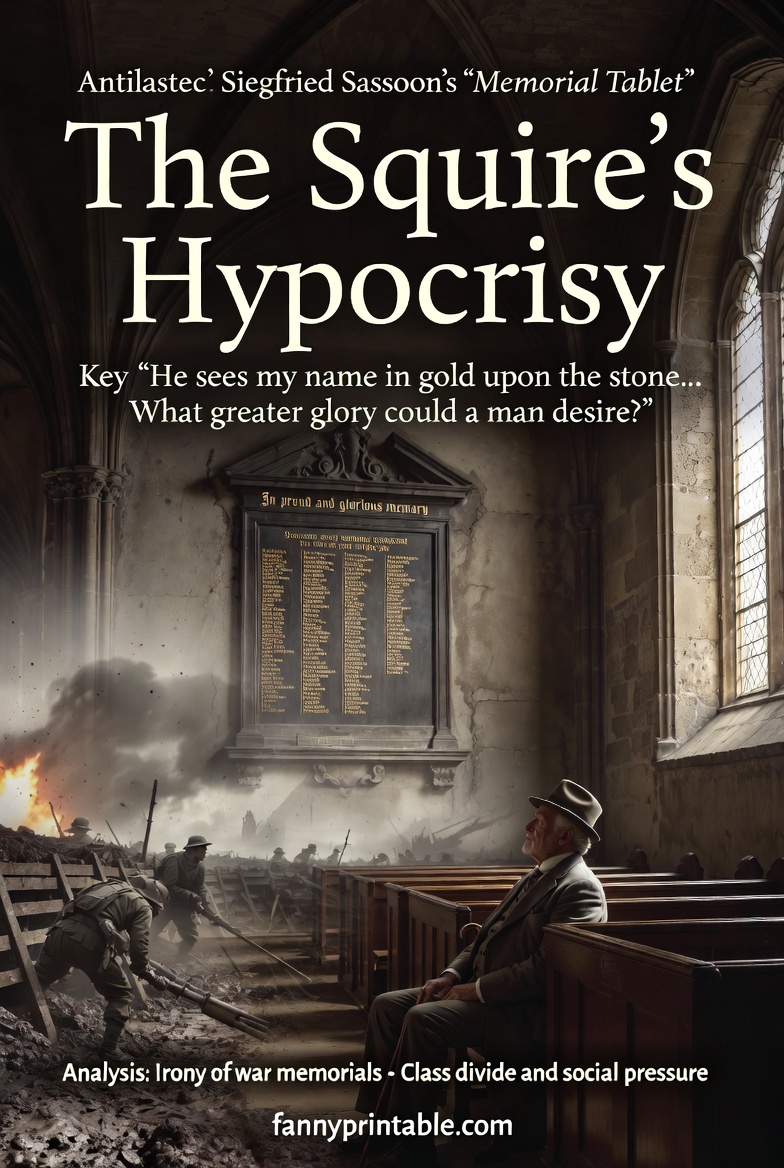
Sassoon attacks the sanitized language of memorials (“proud and glorious memory”). These tablets erase the mud, fear, and coercion, turning dead soldiers into symbols for the living to admire.
Class Divide and Social Pressure
The Squire represents Britain’s landed gentry—safe at home, yet quick to send working-class men to die “for Squire.” The poem highlights how social hierarchy fueled recruitment.
Horrors of Trench Warfare and Passchendaele
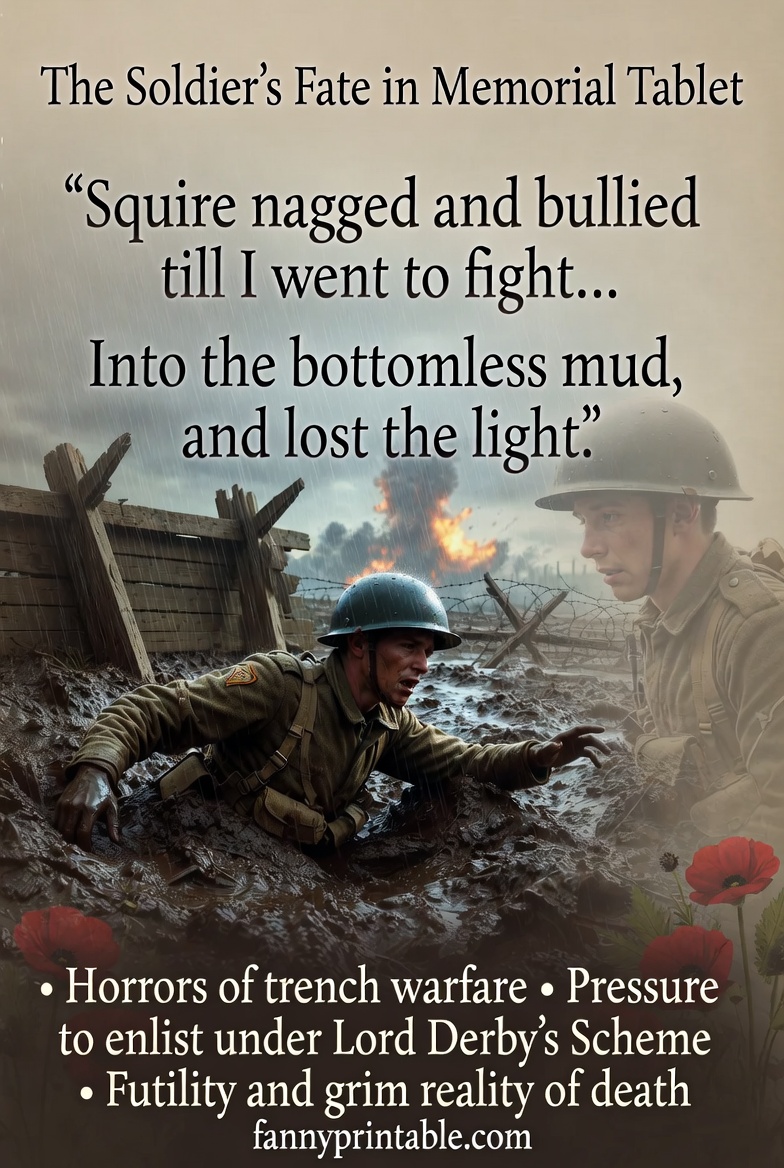
Passchendaele (July–November 1917) became synonymous with futility: over 500,000 casualties in knee-deep mud. Sassoon’s description of drowning after a minor wound captures the randomness and indignity of death.
Anti-War Critique and the Futility of Sacrifice
Through the dead speaker’s voice, Sassoon questions the entire war narrative. The poem rejects romantic notions of heroism, showing instead coercion, suffering, and oblivion.
Memorial Tablet by Siegfried Sassoon: Poem Analysis

Literary Devices and Techniques
- Dramatic Monologue: The dead soldier speaks directly, creating intimacy and accusation.
- Irony and Sarcasm: The closing question is masterfully sardonic.
- Parenthetical Asides: Interruptions like “(They called it Passchendaele)” and “(Under Lord Derby’s Scheme)” add conversational realism and bitter contrast.
- Imagery: Mud, shells, duck-boards, and “bottomless” darkness immerse readers in the trenches.
- Sonnet Form: The poem follows a loose sonnet structure (octave + sestet), traditionally used for love or praise—Sassoon subverts it for protest.
- Caesura and Enjambment: Breaks and run-on lines mirror the chaos of battle and the soldier’s interrupted life.
Historical Context
Written in October 1918 as the war neared its end, “Memorial Tablet” reflects the growing disillusionment among soldiers and civilians. Lord Derby’s Scheme encouraged men to attest voluntarily with the promise they would serve together. Passchendaele, fought in Belgium, saw some of the worst conditions of the war: constant rain turned the battlefield into a swamp where men and horses drowned without ever reaching enemy lines.
Sassoon, who fought in France and was wounded, drew from personal experience. By 1917 he had publicly protested the war, throwing his Military Cross into the Mersey River.
Legacy and Why “Memorial Tablet” Still Matters
Over a century later, “Memorial Tablet by Siegfried Sassoon” continues to resonate. It reminds us that war memorials can obscure as much as they honor. In an age of ongoing conflicts and public remembrance ceremonies, the poem asks uncomfortable questions: Who truly benefits from war? Whose names appear on tablets, and whose suffering is forgotten?
Teachers, students, and history enthusiasts frequently study this poem alongside works by Wilfred Owen and Rupert Brooke to understand the full spectrum of WWI literature—from idealism to bitter protest.
Final Thought: Siegfried Sassoon’s Memorial Tablet is more than a poem—it is a voice from the grave demanding we remember the human cost behind every gilded name. Its message remains as urgent today as it was in 1919.