Table of Contents
Printable Sudoku puzzles let you work through a number-placement challenge with a pencil and a clear paper grid. Choose a smaller introductory puzzle or a classic 9-by-9 layout below. Each PDF includes the puzzle on page one and its verified unique solution on page two, so you can check a finished grid or review a difficult square.
Printable Sudoku PDFs With Solutions
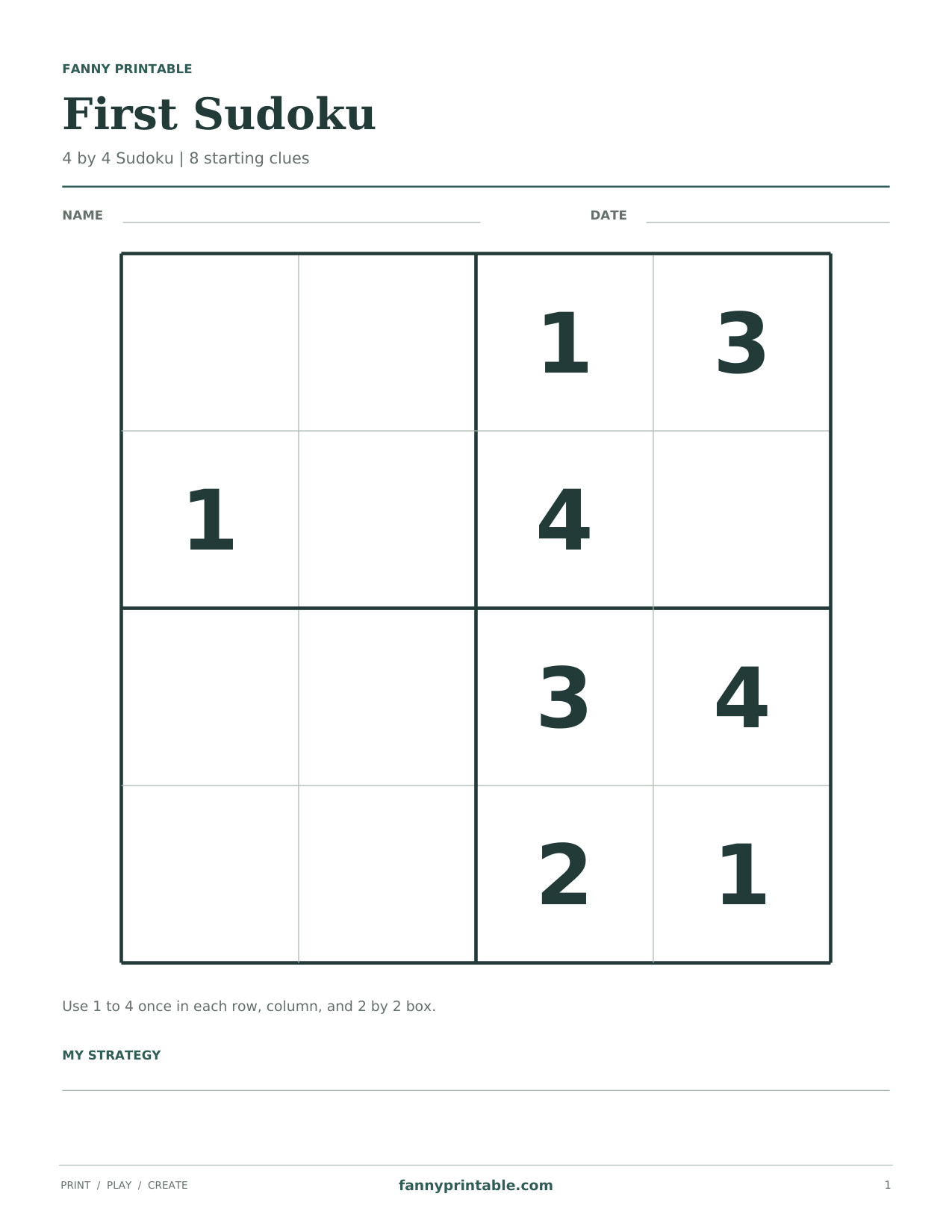
A 4 by 4 Sudoku with 8 starting clues and 2 by 2 boxes. Use 1 to 4 once in each row, column, and 2 by 2 box. The second page contains the verified unique solution.
Download First Sudoku PDF
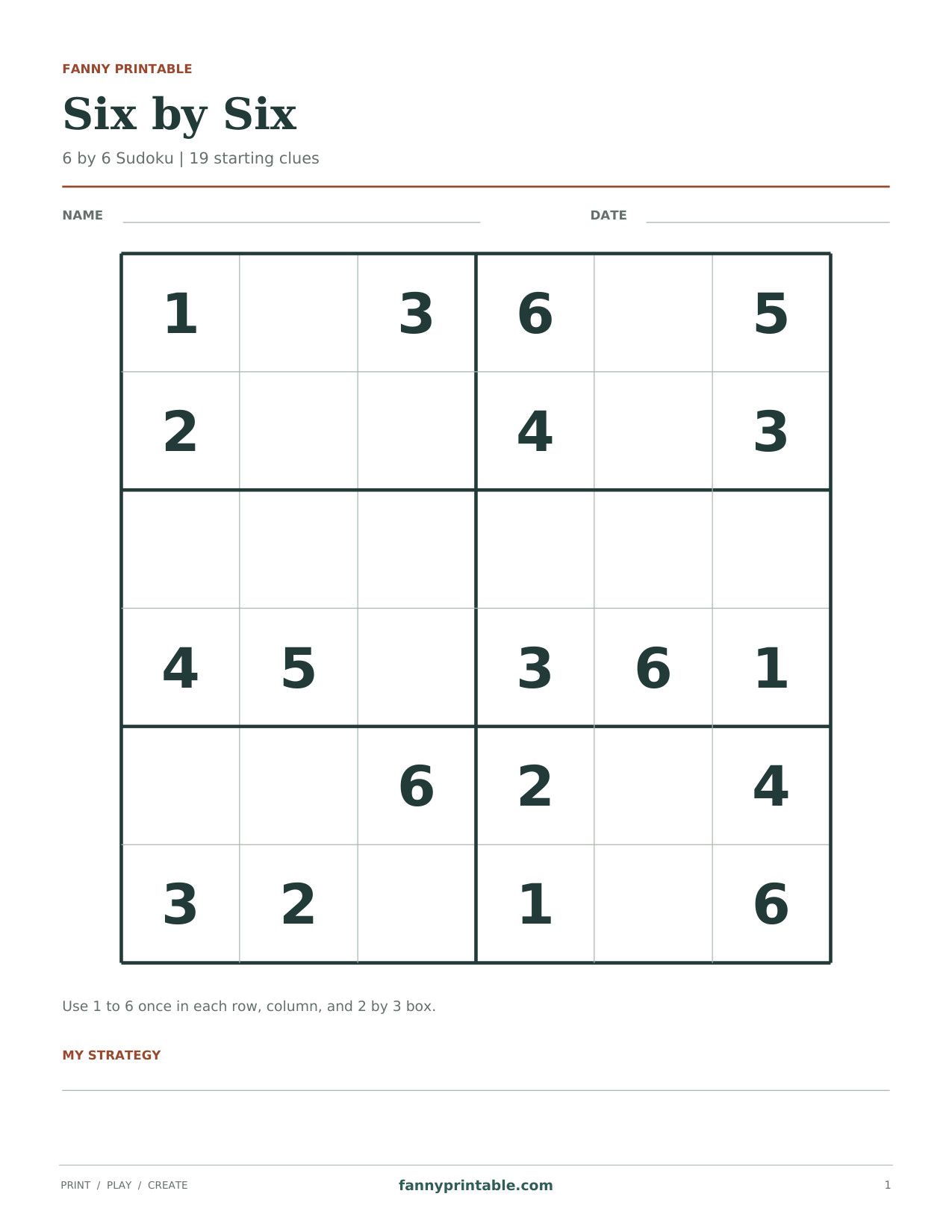
A 6 by 6 Sudoku with 19 starting clues and 2 by 3 boxes. Use 1 to 6 once in each row, column, and 2 by 3 box. The second page contains the verified unique solution.
Download Six by Six PDF
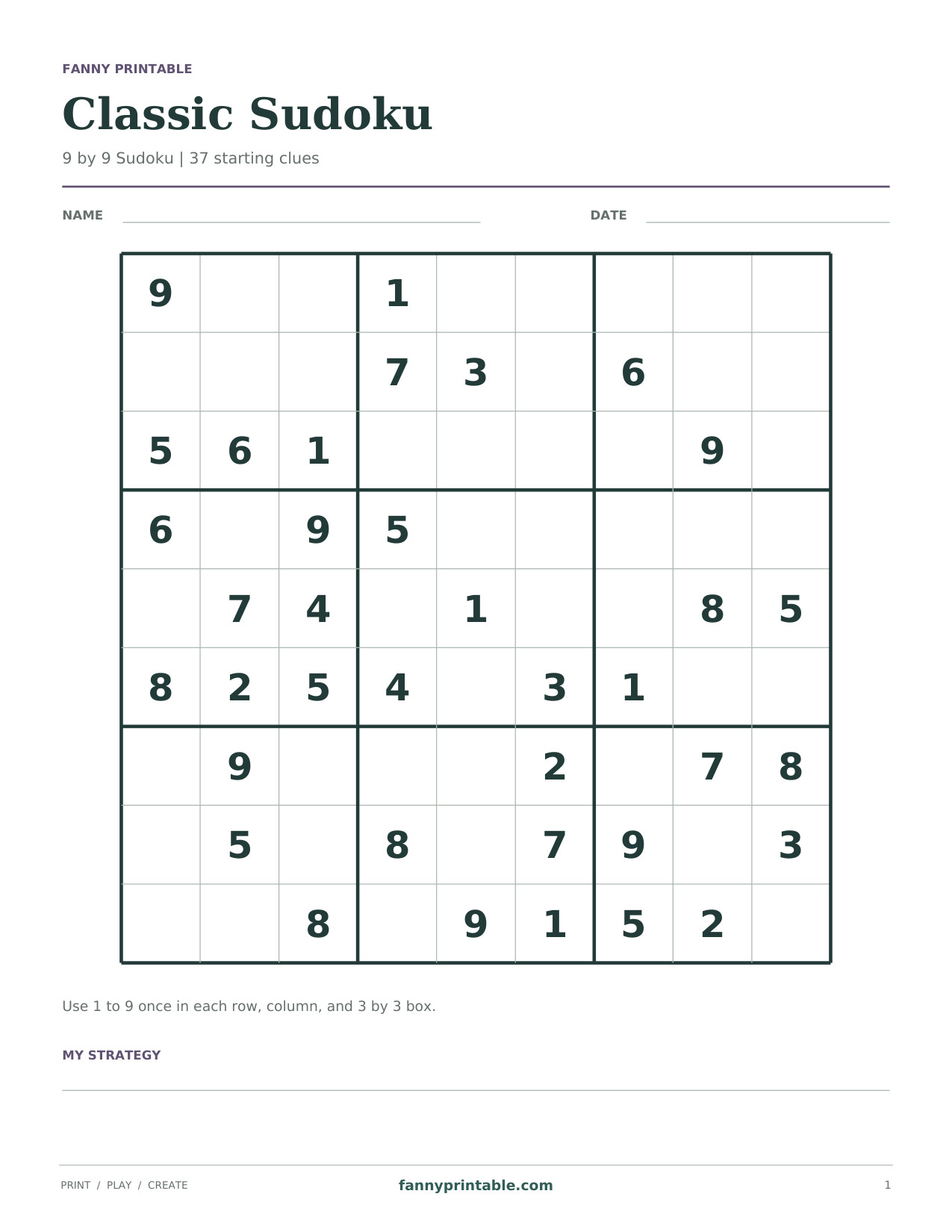
A 9 by 9 Sudoku with 37 starting clues and 3 by 3 boxes. Use 1 to 9 once in each row, column, and 3 by 3 box. The second page contains the verified unique solution.
Download Classic Sudoku PDF
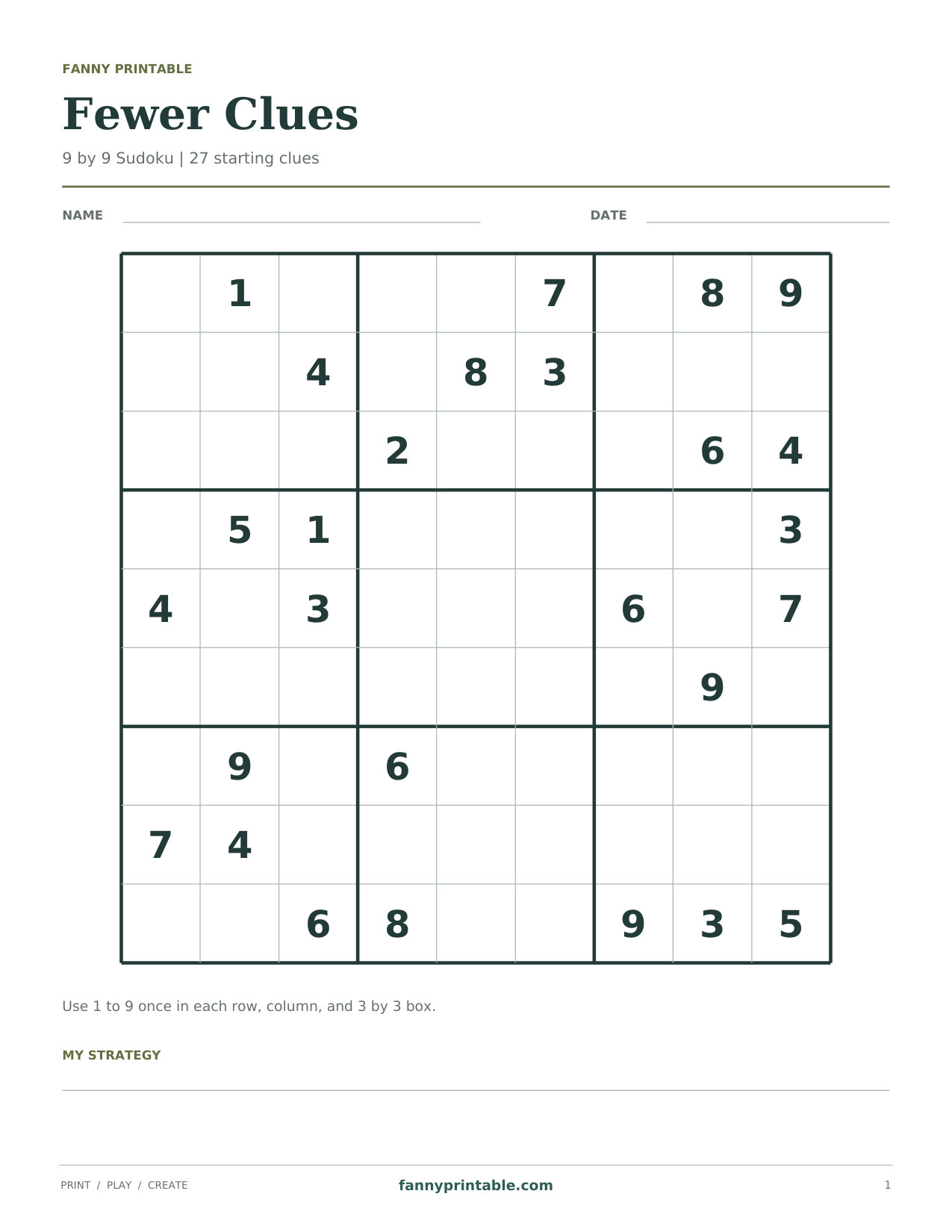
A 9 by 9 Sudoku with 27 starting clues and 3 by 3 boxes. Use 1 to 9 once in each row, column, and 3 by 3 box. The second page contains the verified unique solution.
Download Fewer Clues PDF
Which Sudoku Grid Should You Start With?
The rules stay consistent across the collection, but the number range and box shapes change with the grid. Start with a size that feels manageable and read the instructions printed on that sheet. In particular, the 6-by-6 puzzle uses rectangular boxes rather than the square boxes found in the other sizes.
| Puzzle | Grid Size | Numbers Used | Box Size | Starting Clues |
|---|---|---|---|---|
| First Sudoku | 4 by 4 | 1–4 | 2 by 2 | 8 |
| Six by Six | 6 by 6 | 1–6 | 2 by 3 | 19 |
| Classic Sudoku | 9 by 9 | 1–9 | 3 by 3 | 37 |
| Fewer Clues | 9 by 9 | 1–9 | 3 by 3 | 27 |
The starting clues are the numbers already printed in the grid. Keep them unchanged. The “Fewer Clues” title describes the number of given entries; it is not a promise that every solving step will be harder than every step in the other 9-by-9 puzzle. The position of the clues matters as well as their quantity.
What Are the Rules of Sudoku?
- Every row must contain each permitted number exactly once.
- Every column must contain each permitted number exactly once.
- Every outlined box must contain each permitted number exactly once.
- Fill the empty squares without changing the printed clues.
Use 1 through 4 on the 4-by-4 sheet, 1 through 6 on the 6-by-6 sheet, and 1 through 9 on a classic sheet. Sudoku uses numbers as labels: you do not need to add rows, multiply columns, or reach a target total. A number is correct only when its placement respects all three areas that meet at its square.
How to Begin Solving a Printable Sudoku
- Scan for a nearly complete area. Look for a row, column, or box with only a few blank squares.
- List the missing numbers. Compare the printed entries with the number range for that grid.
- Check one empty square. Eliminate numbers that already appear in its row, column, or box.
- Write a definite answer. If only one permitted number remains, place it in the square.
- Review the affected areas. The new number may make another square easier to solve.
- Repeat and check. Work through the grid, then confirm that every row, column, and box follows the rules.
For example, a 4-by-4 row containing 1, 3, and 4 is missing 2. The remaining square must also agree with its column and 2-by-2 box. If that creates a duplicate, look back for an earlier mistake instead of forcing the entry.
Use Small Pencil Notes When Needed
On a larger grid, write possible numbers lightly in a corner of a blank square. Treat these as notes, not completed answers. After placing a definite number nearby, remove notes that are no longer possible. Keeping the notes small leaves room for a clear final entry.
Look for One Place a Number Can Go
Sometimes a square has several possible numbers, but one missing number has only a single possible position within a row, column, or box. Check the other areas crossing those positions to eliminate options. When only one position remains, you can place that number without guessing.
Printing and Preparing the Pages
The downloads are portrait US Letter PDFs. Open the chosen file, set the paper size to Letter, and inspect the print preview. Start with actual size or 100% scale. If the printer clips the outer border, use fit to printable area and check that the numbers are still easy to read.
Print page one for the puzzle and keep page two separate. A pencil and a clean eraser are usually the simplest tools. If you are preparing copies for a group, print one test sheet before running the rest, particularly when a printer is set to multiple pages per sheet by default.
What Should You Do When You Get Stuck?
Pause and check for duplicate numbers before adding more entries. Then choose a different row, column, or box and work on that area. An answer in another part of the grid can change the possibilities in the square that originally stopped you.
If you use the solution page, reveal just the portion you need. After checking one entry, return to the puzzle and see what follows from it. There is no need to erase printed clues or change the rules to make a guess fit.
Are Answer Keys Included?
Yes. Page two of every PDF contains the corresponding completed solution. The puzzle grids were checked for a unique solution. Use the matching answer page, since a solution from a different grid or size will not apply.
For another quiet activity, try the printable word searches. If you want a task based on counting in order and drawing a picture, choose a connect the dots worksheet instead.